
GEO vs SEO: What Agencies Need to Know About Generative Engine Optimization
They overlap, but they're not the same game — and agencies treating them as identical are going to fall behind.
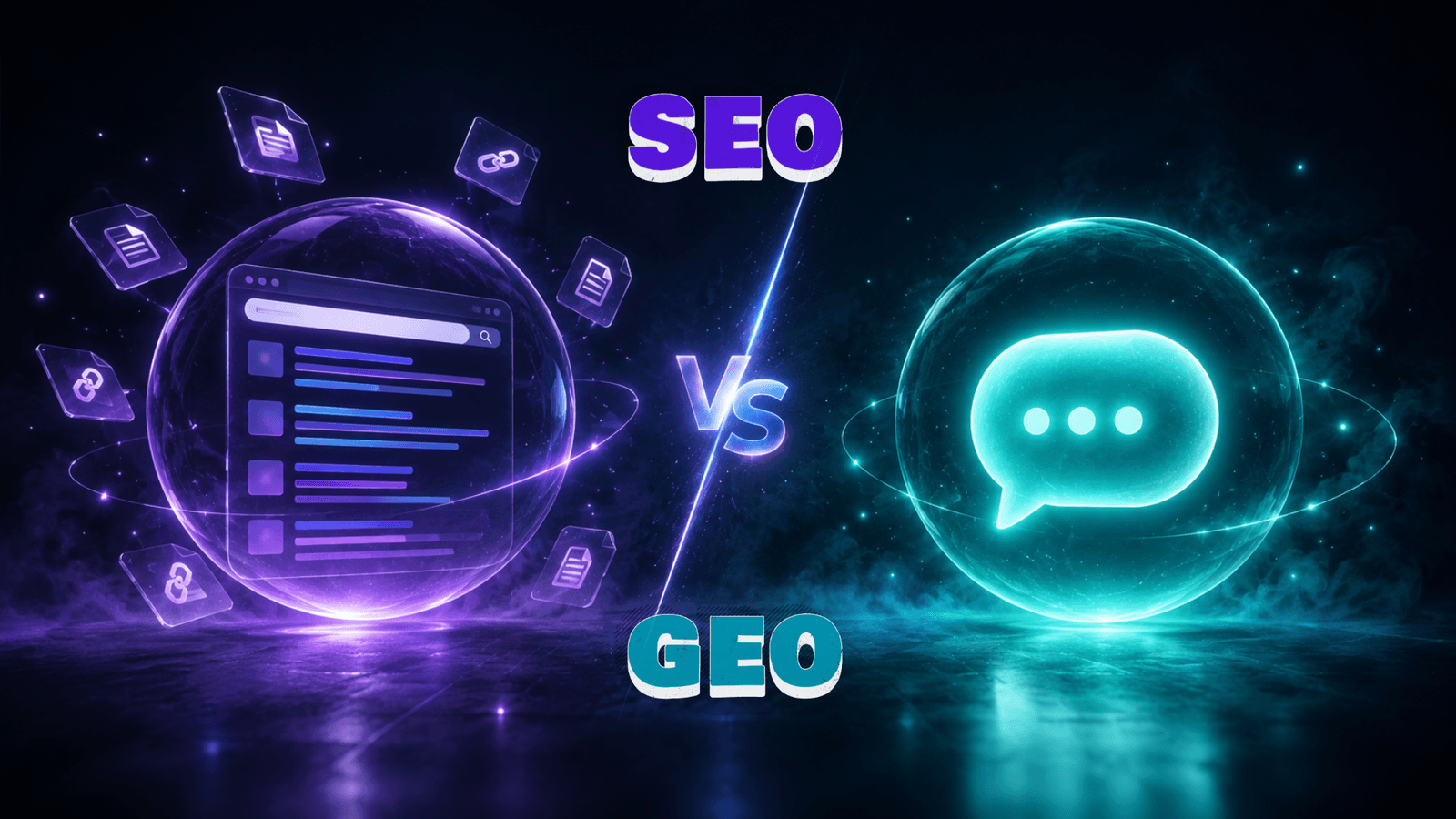
Generative engine optimization is the practice of getting content cited inside AI-generated answers, while traditional SEO focuses on ranking in search engine results pages. They overlap, but they're not the same game — let's break down what's different, what's the same, and why it matters for client work.
So What's the Actual Difference Between GEO and SEO?
At the core, both are chasing the same thing: visibility. But visibility means something different depending on which one you're talking about.
SEO is about earning a spot on a search engine results page. You optimize for keywords, backlinks, page speed, and a long list of other ranking signals, and if it works, your client's link shows up somewhere on Google.
What is generative engine optimization? Generative engine optimization (GEO) is the practice of structuring and strengthening content so AI tools like ChatGPT, Gemini, and Perplexity cite it directly inside their generated answers — a different mechanism than earning a ranking on a traditional search results page.
Generative engine optimization is a different animal entirely. When someone asks an AI tool a question, there's no list of ten blue links to scroll through. There's one answer, generated from a small handful of sources the model decided it could trust. GEO is the work of becoming one of those sources.
Same broad goal of "get found," but a completely different mechanism for actually getting there.
GEO vs SEO: A Side-by-Side Comparison
| Factor | SEO | Generative Engine Optimization |
|---|---|---|
| Target platform | Google, Bing, other search engines | ChatGPT, Gemini, Perplexity, AI Overviews |
| Success metric | Keyword rankings, organic traffic | AI citations, brand mentions in generated answers |
| Content style | Keyword-optimized, link-friendly | Direct, structured, easily extractable |
| Key ranking factors | Backlinks, on-page SEO, site speed | Clarity, entity signals, factual accuracy, structure |
| Measurement tools | Google Search Console, rank trackers | Emerging AI citation tracking tools |
| Maturity of the field | Established, well understood | New, still figuring itself out |
Honestly, this table is worth revisiting every few months. GEO measurement tools especially are moving fast — what counts as "emerging" today might just be the standard way of doing things a year from now.
Why Does AI Content Visibility Matter More Than It Used To?
A few years back, this whole conversation wouldn't have made sense to have. Now it does, because the way people search has genuinely changed. More people are typing questions straight into ChatGPT or Perplexity instead of Google, and getting one confident answer back instead of a page of links to dig through themselves.
"If a client ranks #3 on Google but never gets mentioned in an AI-generated answer, they're invisible to a growing slice of their audience."
Jundalo Technologies — GEO vs SEO PerspectiveAI content visibility is turning into its own KPI, separate from traditional rankings but still very much connected to them. This is exactly why more agencies are starting to treat generative engine optimization as its own service line instead of just a footnote tucked under SEO.
Should Agencies Pick GEO or SEO? (The Honest Answer)
Framing it as GEO vs SEO makes it sound like a decision you actually have to make. In practice, it's really not.
- ✓SEO is still the foundation. Search engines aren't disappearing anytime soon, and most traffic still flows through traditional search — for now, at least.
- ✓GEO sits on top of that. It's not replacing SEO — it's extending visibility into a channel SEO alone can't reach.
- ✓The two actually feed each other. Content that's well-structured and authoritative tends to do well in both.
- ✓Clients rarely have to pick one. Most agencies are better off offering both together than positioning them as competing options.
"GEO or SEO, which one do I need?"
The honest answer is almost always "both, just weighted differently" depending on what the client is trying to achieve.
How Do You Actually Improve AI Content Visibility?
A handful of things consistently move the needle here.
Direct answers first
AI models favor content that states the answer clearly before explaining — not the reverse.
Clear entities
Say exactly who or what you're talking about — vague pronouns hurt extraction accuracy.
Real data
Specific numbers and dates get cited far more than vague marketing language.
Logical structure
Headers, lists, and short paragraphs make content easier for AI systems to parse and quote.
None of this replaces solid SEO work. It builds directly on top of it. That's really the whole point.
How Do You Verify Generative Engine Optimization Work Is Actually Working?
Since this field is still so new, verifying it looks a little different than verifying SEO does.
Ask for direct examples of citations. Ask how citations are actually tracked. Compare before-and-after content. Be wary of anyone overpromising fixed-timeline results. Confirm it's paired with solid SEO underneath.
Generative engine optimization done in isolation, without a strong SEO foundation, tends to underperform — so treat GEO as an addition to a working SEO base, not a replacement for one.
Why Agencies Pair SEO and GEO Through Jundalo
Most providers still treat GEO as an afterthought bolted onto an existing SEO package. That approach misses the point — the two need to be built together, not stacked on top of each other after the fact.
Jundalo Technologies delivers SEO and generative engine optimization as one integrated white label service, so agencies get a single strategy that covers both traditional rankings and AI citation visibility — not two disconnected workstreams.
- ✓SEO and GEO strategy built together from day one, not bolted on later
- ✓Fully white-labeled reporting your agency can present as its own
- ✓Transparent AI citation tracking alongside standard rank reporting
- ✓Ahmedabad-based team with global delivery across time zones
Frequently Asked Questions
Is generative engine optimization replacing SEO?
What does AI content visibility actually mean?
How is GEO vs SEO measured differently?
Do I need a specialist for generative engine optimization, or can my SEO team just handle it?
When should an agency actually start offering generative engine optimization?
Ready to run SEO and GEO
as one strategy?
Partner with Jundalo Technologies for white label SEO and GEO services that plug straight into your existing offering — fully branded, fully reported, zero overhead.