
Business development services are not cold calling. They are not a department. They are the connective tissue between what your company does and who needs it — and when that tissue is healthy, growth becomes a system, not a gamble.
Why Most Companies Misunderstand Business Development
Most organisations treat business development as a sales support function. A few people chasing leads, sending decks, attending trade shows. That is not strategy. That is activity mistaken for progress.
The companies growing fastest in 2026 — from mid-sized SaaS firms to manufacturing exporters — have figured out something the rest haven’t: when business development services are powered by the right technology and executed by the right partner, they compress years of organic growth into quarters.
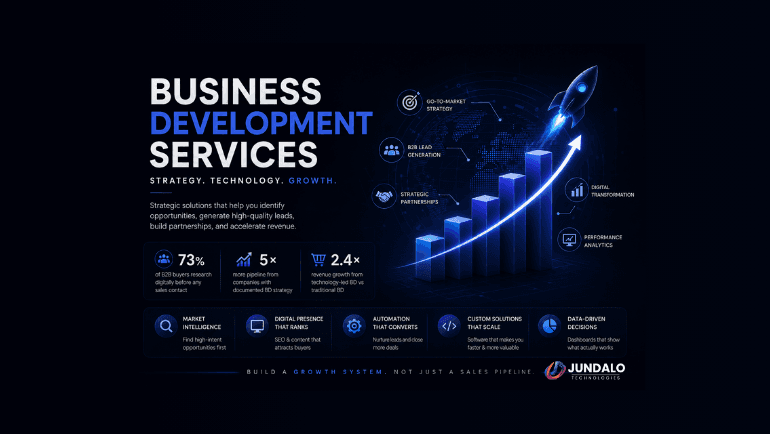
What are business development services? Business development services are strategic solutions that help organisations identify growth opportunities, build high-value partnerships, enter new markets, and accelerate revenue through a combination of digital tools, process design, and consultative execution — delivered by an external partner or specialist team.
The difference between companies that scale and those that stall almost always comes down to whether they treat business development as a cost centre or a growth system. One is managed, the other is engineered.
Digital Transformation Services: The Engine Behind Modern Business Development
You cannot separate business development from digital infrastructure anymore. The two have merged.
Consider how the best B2B companies find clients today. They are not knocking on doors. They rank on page one for buyer-intent searches. They have CRM systems that score leads automatically. They run multi-channel outreach sequences that personalise at scale. They use data dashboards to know which markets are heating up before competitors even notice.
“Digital transformation is not a destination. It is the infrastructure that lets business development happen at a scale no sales team could achieve manually.”
Jundalo Technologies — IT Growth Perspective
This is what digital transformation services look like when applied to business development — not just digitising existing processes, but redesigning growth from the ground up using technology as the primary lever.
What technology-led business development actually includes
-
- ✓Market intelligence tools that surface high-intent prospects before they reach competitors
- ✓SEO and content infrastructure that captures buyers at every stage of their research journey
- ✓CRM and marketing automation that nurtures leads without manual effort or dropped follow-ups
- ✓Custom software that makes your service delivery visibly faster and more valuable than competitors
- ✓Analytics dashboards that tell you which acquisition channels are actually profitable
That is not a marketing strategy in isolation. That is a growth operating system — and it is what separates companies that forecast revenue from those that hope for it.
B2B Lead Generation: Where Business Development Services Pay Off First
Of all the components that fall under business development services, B2B lead generation is where most clients see ROI quickest — and where the quality of your technology partner matters most.
Effective B2B lead generation in 2026 is built on four pillars. Miss one, and the whole system underperforms.
Most companies have one or two of these working. Few have all four aligned. That gap is where business development services create their most immediate value.
Go-to-Market Strategy: The Blueprint Every Business Development Programme Needs
Before any outreach begins. Before any campaign launches. Before any partnership conversation starts. A go-to-market strategy defines who you are selling to, where they exist digitally, what they care about, and how your offer maps to those priorities.
Without this, business development becomes expensive guesswork. With it, every channel, every message, and every outreach effort works from the same blueprint — and compounds rather than collides.
Which industries are underserved by your current offer? Which geographies represent the highest-margin opportunity? At which stages of the buyer journey are you currently invisible? What proof points do you need to earn trust in each segment?
These are not quick questions. Answering them properly requires market research, competitive analysis, and data — which is why organisations increasingly partner with technology solutions providers that can both design the strategy and build the systems to execute it.
Choosing a Proven Partner — Why Expertise in Both Technology and Strategy Matters
There is no shortage of agencies offering business development services. Most specialise in one half of the equation — either strategy or technology. Rarely both. And that separation is where execution breaks down.
Jundalo Technologies was built to close exactly that gap. As a global IT solutions and digital growth company, the team combines custom software development, digital marketing, CRM implementation, SEO infrastructure, and go-to-market consulting under one roof — serving clients from Ahmedabad to Amsterdam, from Bangalore to Boston.
What makes the approach different is integration. Rather than handing a growth strategy to a separate development team who has never read it, Jundalo builds the strategy and the systems simultaneously — so the technology serves the growth goal from day one, not as an afterthought three months later.
- ✓End-to-end delivery: strategy, design, development, and marketing in one team
- ✓Ahmedabad-based with global delivery capability across time zones
- ✓Startup-friendly pricing with enterprise-grade security and scalability
- ✓Agile sprints — you see real progress every two weeks, not just slide updates
- ✓Transparent reporting across every channel, campaign, and conversion metric
Strategic Partnership Development: The Most Underused Growth Lever
Revenue from direct sales has a ceiling defined by your team’s capacity. Revenue from strategic partnerships does not.
Strategic partnership development — a core pillar of any mature business development programme — focuses on building relationships with complementary businesses, distribution channels, and industry networks that send qualified clients to you consistently, without proportional sales effort on your end.
For IT companies and digital service providers, this typically means: technology partnerships with platform providers, referral networks with complementary agencies, white-label arrangements with firms that serve the same client base, and co-marketing relationships that expand reach into target markets.
None of this happens without a structured, systematic approach — and digital tools to manage the partnership pipeline at scale. The companies that build this layer into their business development programme rarely need to rely solely on outbound ever again.